What do waste management, drayage, courier, transit, school bus, and trucking fleets have in common? We work with them all at Flipturn.
And along the way, we've learned some nuanced lessons about what really matters to operators in each segment.
Transit agencies
Transit agencies care most about two things.
Customization. Each transit agency works a little differently, so it's valuable when the product flexes to meet different needs. Spokane Transit, for example, needed designated opportunity chargers exempt from site-wide power management, a configuration that required flexible power allocation rules rather than a one-size-fits-all approach.
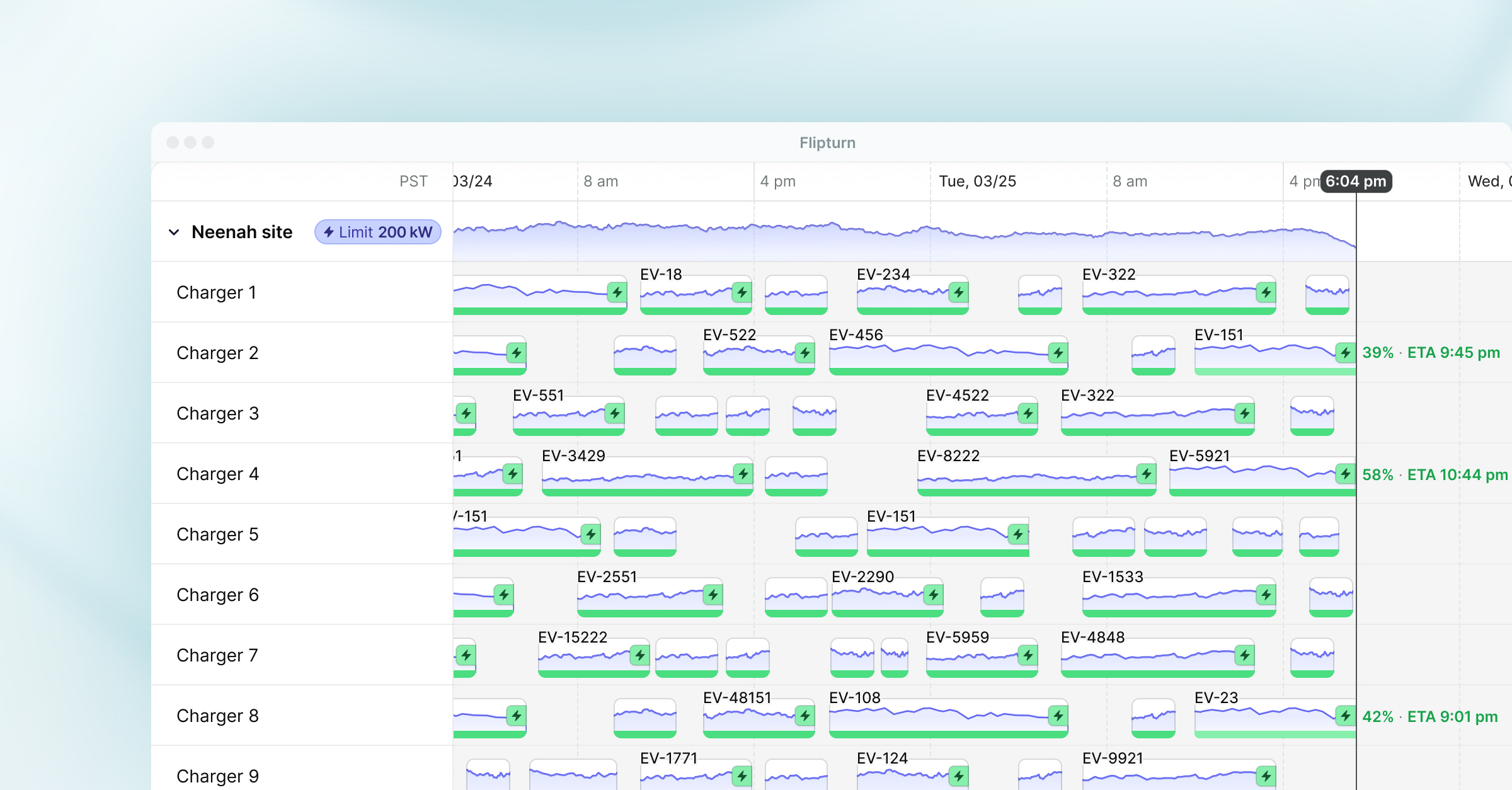
Visibility. The most empowering thing you can give a transit operator is a clear view into what's going on with their assets at any moment. Often, a depot-based view that arranges the chargers in the same positions they sit in real life is the most intuitive way to provide that visibility. This is exactly why we built our custom depot view designer.
Waste management & drayage
These operators care deeply about cost optimization. With high energy consumption across large fleets, even small improvements in power management can translate to significant savings. A drayage fleet running heavy-duty trucks consumes far more energy per vehicle than a transit bus, so demand charge management and time-of-use rate optimization become critical levers.
We've seen customers in this segment save substantial amounts per site per month through more rigorous power management, often up to $1,000 monthly without any impact to operations.
Courier & delivery
Speed and uptime are everything. Vehicles need to be charged and ready for dispatch on tight schedules, so any charger downtime has an immediate revenue impact. A faulted charger at 6 AM means a delivery van that can't make its route, which means missed deliveries and unhappy customers.
For courier fleets, our Flip AI daily health reports are especially valuable. Operators check them first thing in the morning to understand what they're walking into: which chargers had issues overnight, which vehicles are fully charged, and whether any action is needed before dispatch.
School bus fleets
School bus operators need predictability above everything. Routes are fixed, schedules are known in advance, and parents expect buses to show up on time. Charging operations have to be rock-solid. There's zero tolerance for a bus that isn't ready because of a charging failure.
For school bus fleets, FIFO prioritization and overnight power management work together to ensure every bus is charged in the right order and ready for morning routes.
The common thread
Despite different priorities, every fleet segment shares one need: a platform flexible enough to adapt to their specific workflow while providing the reliability and visibility that modern operations demand.
This is exactly why Flipturn is built to be configurable rather than one-size-fits-all. The same platform that manages opportunity charging for a transit agency also optimizes overnight charging for a delivery fleet and ensures predictable operations for a school district. The underlying engine is the same. What changes is the configuration, tailored to each customer's operational requirements.
If you operate an EV fleet of any size or type and want to see how Flipturn fits, book a demo.
About Flipturn
Flipturn is the unified control center for EV charging operations, built for properties, businesses, and fleets. Whether you're managing a private depot or a public charging site, Flipturn helps you stay online, cut costs, and keep EV operations running smoothly. Control energy usage, manage access, accept payments, and remotely monitor operations across your chargers and vehicles, all in one place.