As robotaxi services expand, operators are racing to stand up new depots and grow existing ones. Utility capacity constraints are one of the major slowdowns, partly because the time to resolution is so long compared to how quickly fleets need to move.
Luckily, there are options for shortening that timeframe. A combination of flexible utility programs and power management can help autonomous fleet operators access more charging capacity faster, even while waiting on the physical infrastructure to catch up.
Why capacity is a bottleneck for autonomous fleets
Robotaxis and other autonomous transit almost always depend on DC fast charging (DCFC) rather than Level 2 (L2). Vehicles need to charge quickly between dispatches, and L2 doesn’t turn vehicles around fast enough at the utilization rates these fleets run. DCFC units draw significantly more power per port (150 to 350kW), so the aggregate power required at a depot adds up quickly as a fleet grows.
Adding more chargers than the site's electrical service can support requires a utility upgrade, and those upgrades take time. Utility service upgrades can take 12 to 24 months and cost hundreds of thousands of dollars. The delays are due to a combination of:
- Local infrastructure limitations
- Permitting requirements
- Supply chain delays for electrical equipment
- Secondary requirements that get triggered by the upgrade itself (trenching, new electrical rooms, architectural and construction work, etc.)
For fleets who have strict deployment timelines or are actively looking to grow quickly, waiting that long isn’t really workable.
Access capacity faster with flexible connection utility programs
Operators can quickly access more capacity through flexible utility interconnection programs. One option in PG&E territory is Flex Connect, a pilot program that lets eligible sites connect at higher capacity while PG&E completes long-term infrastructure upgrades.
Eligible sites access that additional capacity by staying within PG&E’s scheduled (and real-time) power limits. This is done through an approved charging and energy management system, which automatically adjusts the power draw of the EV chargers. In many cases, the site can access the capacity in a matter of weeks instead of years.
Flipturn is one of three approved solution providers for Flex Connect, allowing customers to participate in the program. Read more about Flipturn’s Flex Connect approval, or speak to our team if you are evaluating Flex Connect for a site.
Flipturn is also OpenADR 2.0b and IEEE 2030.5/CSIP compliant, allowing depots to meet utility requirements and get more power to the site faster.
Other ways to mitigate capacity bottleneck
Even outside of a formal utility program, a well-configured charging management system (CMS) can extend what's possible on existing infrastructure:
Site and subsite-level power limits
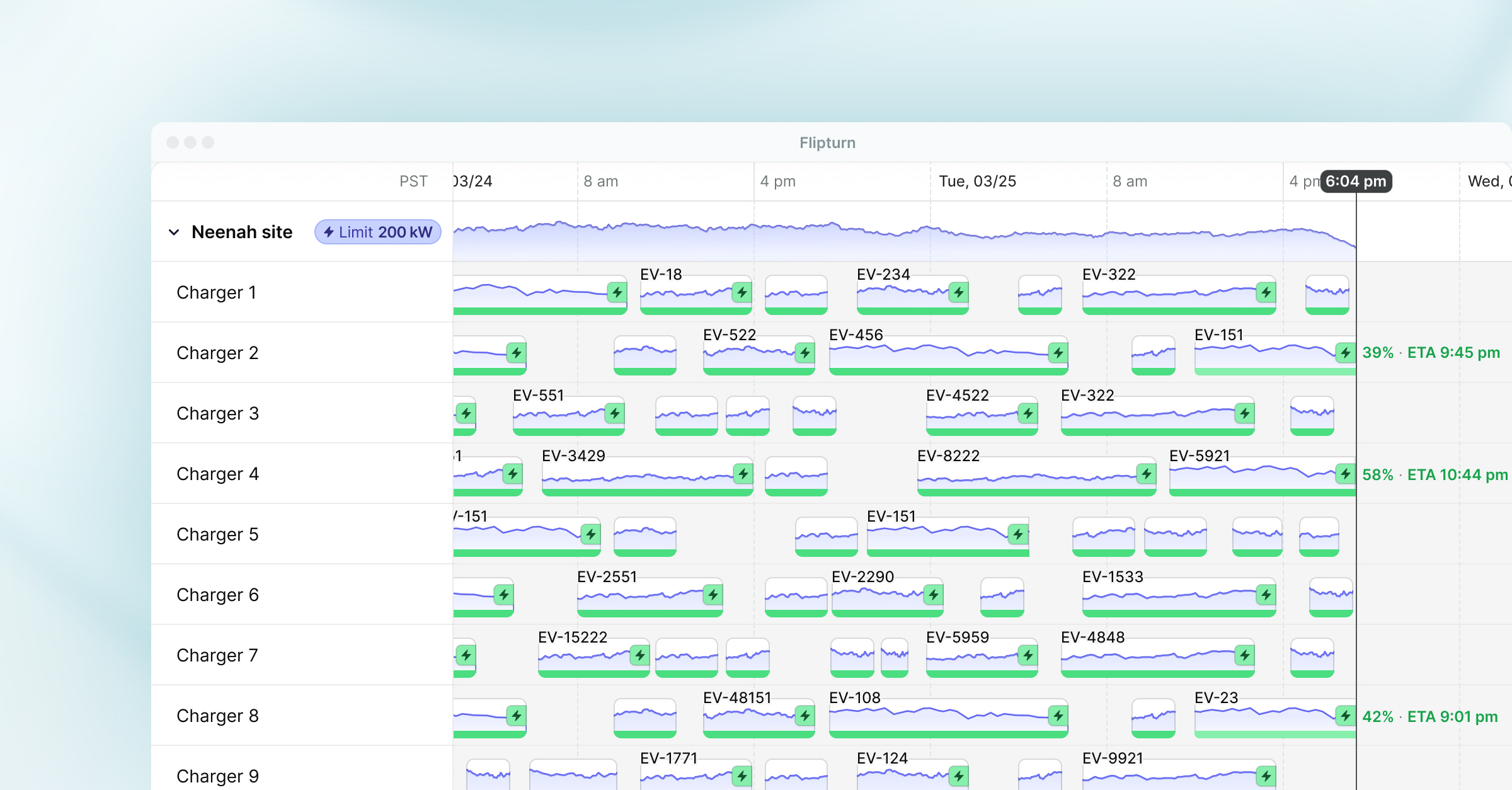
By setting power constraints at the site level and at the subsite level (per panel or transformer), operators can install more chargers than the raw electrical capacity might suggest. The CMS manages power dynamically across active sessions to stay under the limit at any given time, allowing operators to install up to twice as many chargers on the same infrastructure (compared to without power management).
Read more about Flipturn’s energy management capabilities.
Integration of charging with dispatch and vehicle systems
Operators can optimize vehicle assignment and dispatch by integrating real-time charger status and session data with routing systems.
Optimization ensures that no vehicle or charger is ever just sitting there while it could be utilized. For example, operators can immediately route incoming vehicles to the next available charger, versus have a vehicle wait at an occupied charger while there is an available one across the depot.
Summary
Utility capacity upgrades take time, but operators don't have to wait on them entirely before growing depot charging. The main options are:
- Participating in programs like PG&E Flex Connect to access additional capacity ahead of a formal upgrade (for sites in PG&E territory that meet eligibility criteria)
- Using dynamic site and subsite-level power management to increase the number of chargers on existing infrastructure
- Integrating charging management data with dispatch and vehicle systems to optimize utilization and vehicle throughput
If you're evaluating depot charging options for an autonomous fleet and want to understand whether programs like Flex Connect apply to your situation, speak to one of our experts.
About Flipturn
Flipturn is the leading EV charging and energy management platform for businesses and fleets, helping organizations maximize charger uptime, process charging payments, and scale operations efficiently. Backed by leading investors including CRV and Accel, Flipturn serves Fortune 500 companies, commercial property owners, and major fleet operators across North America.