
Most property owners and operators want to know the same two things: what will this cost, and when does it pay back?
This guide walks through everything you need to get commercial EV charging right, whether you're:
- A multifamily property owner adding chargers as a tenant amenity (and looking to offset costs with utility rebates)
- A workplace or business wanting to offer charging as an employee / customer perk
- A retail, hospitality, or parking operator looking to improve the guest experience and generate a new revenue stream
Below, we cover why EV charging matters, how installation works, what drives cost and how to dramatically reduce it, and the pricing + management strategies that make this an actual value-add — whether you're starting from scratch or already have chargers across a portfolio.
What is EV charging?
Electric vehicle charging, or EV charging, is the process of supplying electricity to a vehicle to power its battery. This applies to plug-in electric and hybrid (PHEV) cars. A complete EV charging solution consists of a few major components:
- EV charger: This is the physical unit / hardware that facilitates power flow. There are a few types of chargers, categorized by speed:
- Level 1 (L1, slowest)
- Level 2 (L2, fast) - the most common for commercial properties as they charge reasonably quickly while being affordable
- DC Fast Chargers (DCFC, rapid)
- Charging cable and plug: These are the components that physically connect the charger to the vehicle.
- Electrical infrastructure: The site must have available capacity to support the power demand from charging. Site assessments are necessary to see if additional upgrades (transformers or switchgears) are required.
- User interface: This is usually a screen on the charger that the user interacts with to start charging or pay.
- Charger management system: While not required for all EV charging solutions, an EV charger management system enables remote charger monitoring, maintenance, payments, and optimization.
Why have EV chargers?
Customer attraction and retention
EV charging used to be considered a luxury amenity, but with rapid EV growth over the past decade, available charging has become a baseline expectation.
In multifamily housing, EV charging is a key tenant attraction and retention tool due to the convenience of charging at home. Plus, EV-driving tenants are 2x wealthier on average and are longer-term renters, further supporting the retentive effect that EV charging has. As a result, properties with chargers usually see a 15% increase in value.
For workplaces and businesses, offering easy, reliable EV charging is a simple way to stand out to EV drivers — they notice the extra convenience when they park and become more likely to return. For retail locations specifically, having chargers increases dwell time as the driver stays longer to charge their EV.
As EV adoption accelerates, not having EV charging becomes a dealbreaker, especially for multifamily housing. 80% of EV drivers don’t consider living at a property without chargers, usually filtering them out on Zillow when looking for their next home.
EV charging is critical not just to differentiate from competition, but also to stay on the radar of EV drivers.
Assessing whether or not EV charging is right for your property? Request a competitive analysis of EV charger adoption for other properties in your area. Please mention “competitive analysis” in your submission.
Revenue generation
EV charging can also create a new revenue stream. Depending on your charging management system, you can configure charging fees to cover electricity costs and make additional margin. Here’s an example of what that can ook like in Flipturn’s system:
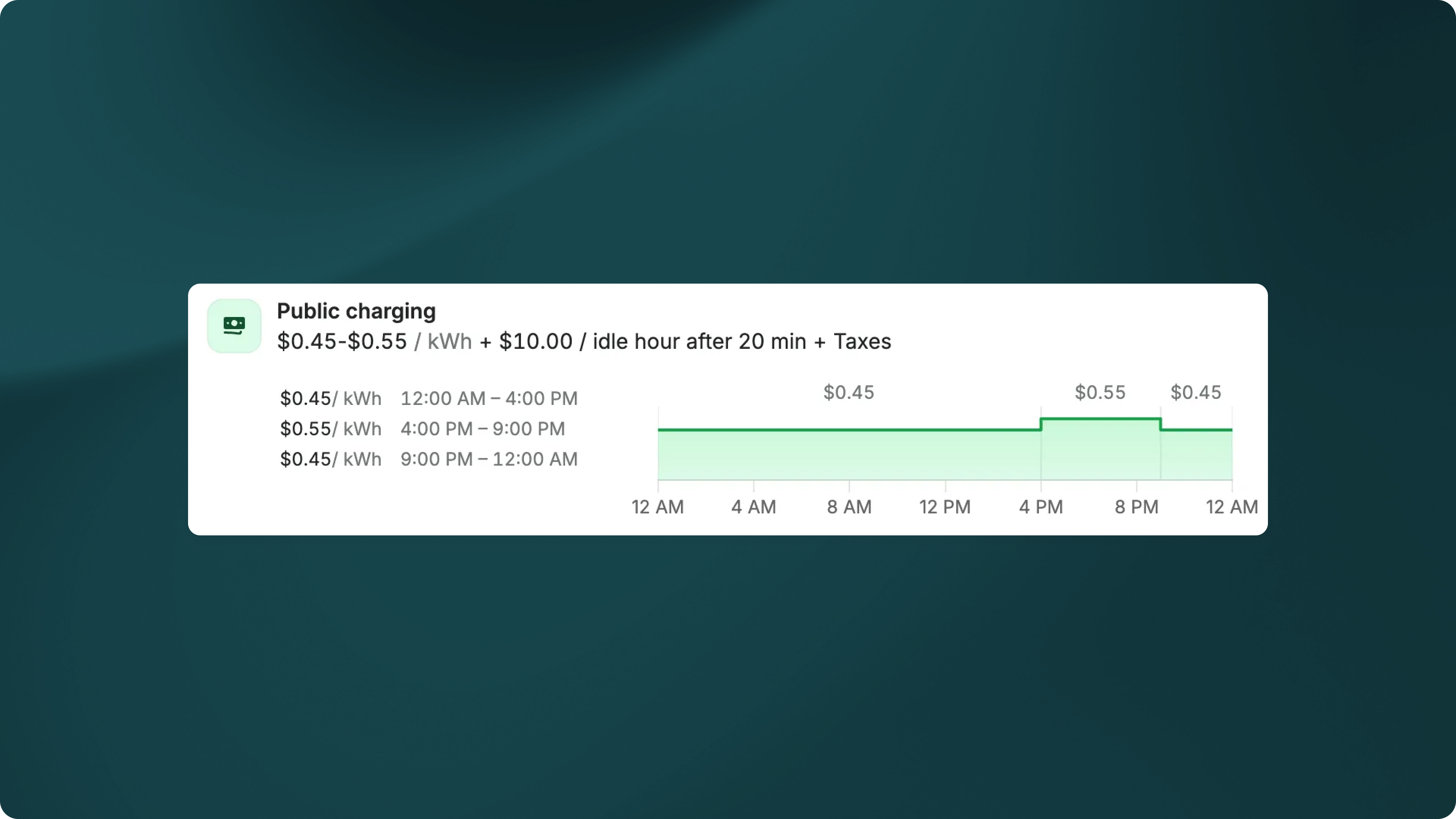
In this example, the operator configures time-of-use fees, meaning the cost to charge varies depending on time of day. From the hours of 4-9pm, when electricity is more expensive, drivers pay more to charge. This method of pricing creates risk-free revenue for the property.
Other pricing models include free charging, which many luxury multifamily operators use to provide a full-service amenity to their residents, or fixed-rate charging (a flat fee).
Is EV charging still relevant given current politics?
Given the current political landscape — slashes in green energy project funds, a renewed focus on oil, the ending of federal EV tax credits — it’s a fair question.
However, despite there being a perceived slowdown in EV interest due to current politics, the reality is that EV infrastructure investment continues to accelerate:
- EV-readiness building requirements: many states, including California, Washington, Colorado, Virginia, and more, have included EV-readiness as part of their new building codes. What this means is that new construction is required to have the necessary capacity and wiring in a portion of their parking spaces for L2 chargers.
- EV charging network expansion: US public EV charging port count grew by over 20% in the past year.
- Utility planning: utility plans for the coming 5-10 years already factor in additional demand from EV charging, and several utilities offer rebates to subsidize EV charger install.
- Auto manufacturing investments: major auto manufacturers have already made huge investments in accelerating the R&D and manufacturing of EVs, indicating that they have high market confidence in the medium-long term.
It’s easy to look at where there’s the most noise, but the most important indicator that EVs are staying relevant is the steady growth in EV infrastructure, which further incentivizes adoption. EV is here to stay!
The installation process: from zero to live chargers
For properties starting from scratch, the installation process for EV charging consists of:
1. Scoping the available utility rebates / cost-savings
Most local utilities offer EV charger rebates for multifamily properties, workplaces, and businesses. In many cases, these rebates can cover 75%+ of costs. Understand which programs are available to you to maximize cost savings. Examples of such programs include:
- PSEG NJ: covers up to $7.5k per L2 charger in installation costs
- PGE: covers up to $3.5k per L2 port, plus another $22k per charger for installation costs (based on zip code eligibility)
- Duke Energy NC: covers up to $1.5k per L2 port for site preparation
- EV Charge SF: covers up to $4.5k per L2 port
Request a rebate eligibility scan here and mention “rebate scan” in your submission.
2. Site evaluation with an EV charging installer
Once you’ve decided to add EV charging to your site, choose a local installer to help evaluate your site. In a site evaluation, the installer determines what the scope of work will be: how many chargers you can add, if electrical upgrades are necessary, how much trenching is needed (if any), and more.
3. Select charger type, quantity, and location
Based on the site evaluation, you or the installer will choose the types of chargers, where they’ll be placed on your site, and how many of them to install.
This is where you’ll get an estimated project cost, and some installers can assist here with rebate application to reduce your out-of-pocket cost.
4. Installation and configuration
After you’ve approved the installer’s project proposal, they proceed with the installation. If other electrical infrastructure work is required, such as a panel upgrade, the process may take longer. The actual installation and configuration of your chargers is very quick. Once configuration is done, your chargers are live!
All together, this entire process can take anywhere from 1-6 months, depending on rebate approval timeline and actual scope of installation work.
At Flipturn, we make this process as easy as possible by handling everything beyond an initial introduction call to understand your charging needs — we own rebate application, site qualification, and charger installation.
Have a specific question on rebates or installation, or interested in learning more about our turnkey process? Talk with our experts here.
Expected payback
Given that EV charging is a revenue-generating asset, property owners frequently ask: What is the expected payback period?
Generally speaking, properties can expect to see payback within 3-5 years. However, each property is unique, so the true answer varies and depends on a few factors.
- CapEx spend: the initial investment spend on installation and hardware arguably influences payback period the most. Properties should look to optimize utility rebate coverage, or opt for a no-cost solution like Flipturn’s third-party operated model. By minimizing CapEx spend, EV charging can be cashflow positive within months.
- Charging session pricing: revenue directly generated from EV charging can be thought of as price per charging session x number of charging sessions. Optimizing price for revenue generation, while not overcharging drivers, cuts down payback period. Price per session can be set up in several ways, such as:
- Per kWh (priced by electricity usage)
- Per minute (priced by time spent charging)
- Session fees (priced per session)
- Idle fees (priced for extra time spent occupying the charger while not charging)
- Charger utilization: High charger utilizations means more charging sessions, which in turn generates more revenue. Operators can improve utilization by ensuring good charger functionality and high uptime. A good EV charging management system (CMS) is crucial for operators to have visibility into charger function and utilization.
- Electricity costs: the easiest way operators can minimize electricity cost is by configuring time-of-use fees (if the CMS supports it), which matches prices to your utility costs and de-risks revenue. Flipturn’s platform automatically pulls electricity costs and sets prices dynamically to ensure the operator always makes a set margin.
For more information on how to minimize CapEx and operating costs for EV charging at your properties, chat with our rebate and installation experts.
How to get EV charging at no cost
Apart from rebate-subsidized EV charging that uses utility-level incentives to cover installation costs, Flipturn also offers no-cost, third-party operated EV charging for qualified multifamily portfolios.
How this model works:
- The portfolio is evaluated as a whole and qualified for no-cost EV charging
- Upon approval, turnkey installers proceed with all procurement and installation
- The EV chargers are operated by Flipturn’s team, including maintenance and repair
- Property owners get a revenue share after 3-5 years
In this third-party operator model, property owners have less granular control over their charging and may see less financial upside from charger revenue. However, the process is completely no-cost and hands-free in the long term, and works especially well for budget or bandwidth-constrained portfolios.
Portfolios can request qualification for Flipturn’s no-cost charging option. Please mention “no-cost EV charging” in your submission.
Other tips for commercial EV charging
Curious to learn more about how to set up your EV charging for success? Here are some of our other guides and articles on commercial EV charging: