

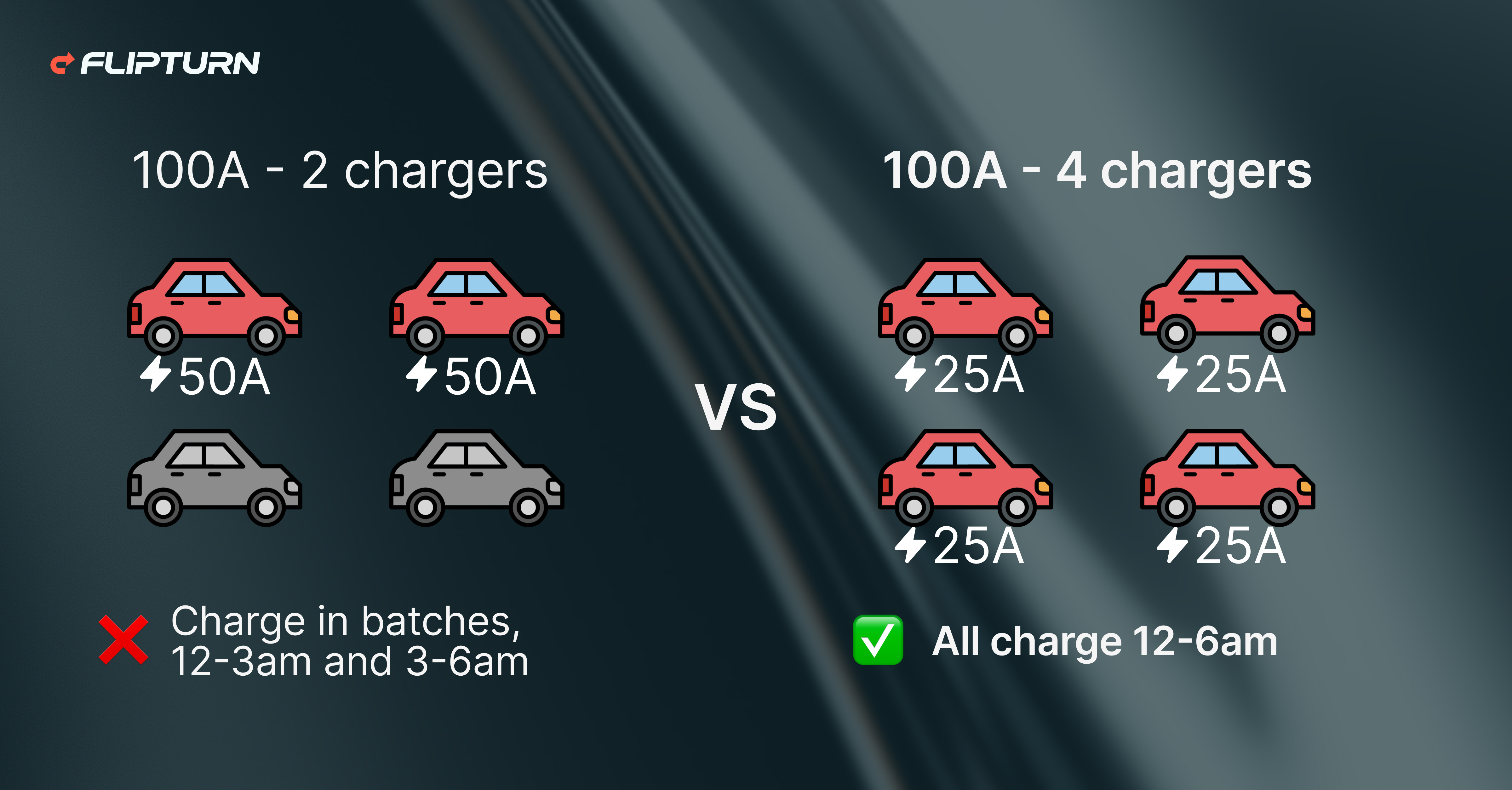
The electrical panel doesn't have to be the bottleneck.
When fleet operators start planning their EV charging infrastructure, the conversation usually starts with a limiting question: How many chargers can our existing electrical panel support?
At first, the math seems simple. You have 200 amps of available capacity. A Level 2 charger pulls 50 amps. That's 4 chargers, right? (Or 3, with the required buffer.) If you need more, time to call the utility and start the painful, expensive process of upgrading your service.
Not so fast.
Unpacking the problem
Traditional infrastructure planning assumes every charger will draw maximum power simultaneously, 24/7. But that's not how fleet charging actually works.
Consider a delivery fleet. Vehicles return to the depot between 3 PM and 5 PM. They need to be ready by 3 AM. That's 10-12 hours of available charging time for vehicles that typically need 3-6 hours to fully charge. Not every vehicle returns at the same state of charge. Not every vehicle needs a full charge.
Rather than asking: "How much power could these chargers theoretically draw?" The question to answer is: "How much power do we actually need to deliver the energy these vehicles require?"
Those are very different numbers.
How dynamic energy management changes the math
Intelligent load management software monitors every charger and every vehicle in real-time, distributing available power based on actual need rather than theoretical maximums. The system knows which vehicles need the most charge, which will be dispatched first, and how much time remains before departure.
Instead of installing four 50-amp chargers that occasionally spike to 200 amps, you install ten chargers sharing that same 200-amp capacity. Each charger delivers power when it's needed, at the rate it's needed. Vehicles still leave fully charged and on time.
The real-world impact is significant. Fleet operators using dynamic power management routinely install double the number of chargers on the same electrical infrastructure compared to unmanaged installations. Some installations achieve even better ratios depending on their operational patterns and dwell times.
What this means for your bottom line
Avoiding or deferring an electrical service upgrade isn't just about the upfront cost—though those costs are substantial (often $50,000-$250,000+ depending on scope). It's about timeline. Utility upgrades can take 12-24 months. That's 12-24 months of delayed fleet electrification, missed sustainability commitments, and competitive disadvantage.
Smart power management also flattens your demand curve, reducing the costly demand charges that can account for 30-50% of commercial electricity bills. By preventing simultaneous peak draws, you're also operating the chargers you have more cost-effectively.
Getting started
If you've been told you need a major electrical upgrade before adding chargers, it's worth a second look. The combination of intelligent load management and realistic analysis of your fleet's actual charging needs often reveals capacity you didn't know you had.
At Flipturn, we tackle this problem across hundreds of EV charging sites. Read about our work with Purolator and Harbinger Motors here.
Curious how you can get more out of your electrical capacity? Let's chat!
About Flipturn
Flipturn is a leading EV charging and energy management platform, helping organizations maximize charger uptime, process charging payments, and scale operations efficiently. Backed by leading investors including CRV and Accel, Flipturn serves Fortune 500 companies, commercial property owners, and major fleet operators across North America.

.jpeg)