
A single uncharged vehicle can cancel a delivery route, which means fleet charging is more than a logistics problem. It's also a financial one.
This guide is for fleet operators who are:
- Managing 10+ vehicles across one or more depots
- Running a delivery, transit, logistics, or corporate fleet and struggling with hefty demand charges
- Dealing with charger reliability issues that only surface when vehicles fail to depart
- Evaluating fleet EV charging software or providers and trying to understand what "enterprise-grade" actually means
Below, we cover: fleet charging infrastructure basics, the four most common operational pitfalls, and the specific optimization strategies — smart scheduling, load management, proactive monitoring — that enterprise operators use to keep uptime above 99% and electricity costs predictable.
What is EV fleet charging?
EV fleet charging refers to the infrastructure used to charge a group of electric vehicles (EVs) that carry out daily business operations. Examples of such fleets include delivery vans, public transit buses, and service trucks (e.g. waste collection and recycling).
Usually, these EVs have predictable schedules, are on the roads for longer periods of time, and are charged at designated depots or sites (compared to consumer EVs, which are often charged at home or at public stations). An EV fleet can have anywhere from a dozen to hundreds of vehicles, all carrying out operations in parallel.
What makes fleet charging unique?
Unlike business, residential, or public charging, EV fleet charging is critical to business function. Vehicles have to be charged and depart on schedule, and chargers must be readily available for when extra charging is needed. A single charger outage or poorly coordinated schedules can cost the business hundreds of thousands in revenue.
For example, consider Purolator, the largest courier network in Canada and one of Flipturn’s customers. If one delivery truck is not charged on time, an entire delivery route may be delayed, stopped early, or canceled entirely.
Additionally, unlike commercial charging, which can be decentralized across properties (each with their own maintenance staff), fleet charging operations are centralized by design. Fleet operators have to coordinate which vehicles will charge at which depots, and when.
At its core, EV fleet charging is a large-scale optimization problem of coordinating known schedules to 1) maximize reliability and 2) minimize costs.
EV fleet charging infrastructure components
While EV fleets operate on a much larger scale than most commercial properties, the charging infrastructure is largely similar, consisting of the following components:
- EV charger: this is the physical unit / hardware that facilitates power flow. There are a few types of chargers, categorized by speed:
- Level 1 (L1, slowest)
- Level 2 (L2, fast)
- DC Fast Chargers (DCFC, rapid)
- Charging cable and plug: these are the components that physically connect the charger to the vehicle.
- Electrical capacity: the site’s electrical infrastructure must be equipped to take on the load / power demand from EV charging. Site assessments are necessary to determine if upgrades are required, such as transformers or switchgear.
- Charger management system (CMS): a CMS is a critical component of EV fleet charging and enables remote charger monitoring and optimization.
L2 chargers and DCFC are the most common for fleets. L2 chargers work well for overnight charging at depots, while DCFCs are best for rapid, high-utilization chargers and minimize dwell time while vehicles are on the go.
Common problems and pitfalls
Given the scale at which EV fleets function, fleet operators usually run into a few common issues that severely impact business efficiency and financial health.
Unreliable charging and poor visibility into charger status
Abnormal charger behavior or failed charging is a huge problem. Without a good charger management system, chargers can fault and impede charging, and no one knows until the affected vehicles fail to depart the next morning.
Electrical capacity constraints
Preventing site overload is a critical part of fleet operations. To stay under total site capacity, fleet operators are usually constrained in the number of chargers they can install, leading to longer charging wait times.
Expensive power consumption
Electricity costs are a huge operational expense, largely bumped up by charging during on-peak hours (late afternoon to early evening, when power is most expensive) and by demand charges (big spikes in power consumption).
Hefty demand charges for fleets are often caused by vehicles all returning from their respective routes at similar times, and all plugging in at once.
Trying to create cost efficiencies by manually staggering charging, such as by having a returning vehicle wait for a few hours before plugging in, is inconvenient / often impossible.
Data overload
Fleet operators are working with mountains of vehicle, charging, and financial data, which are often too large to efficiently analyze with Excel. As such, operational and cost inefficiencies can go unaddressed for months.
If you’re looking to solve a specific problem outside of the ones mentioned above, our fleet experts would be happy to chat. Please elaborate in your submission.
How to optimize fleet operations
Optimizing fleet operations boils down to making sure vehicles are available when needed, electricity costs are predictable and minimized, and day-to-day operations stay manageable even as the fleet grows.
These optimizations are mostly enabled by fleet EV management, primarily through EV charging management software (CMS). These are platforms that collect charger data, coordinate charging, and manage energy usage. Without a CMS, charger control is effectively limited to manual interactions, i.e. the operator has to physically interact with each charger to change its behavior.
Note that CMS platforms vary in capabilities, so below, we’ll discuss fleet optimization as if the operator is using Flipturn's CMS.
Flipturn is a CMS originally built for fleets, so the fleet feature set is more advanced than most well-known CMS providers. If you have a particular question about one of our features, please contact a fleet expert here.
1. Ensuring vehicle availability
Vehicle availability starts with the ability to monitor charging real-time.
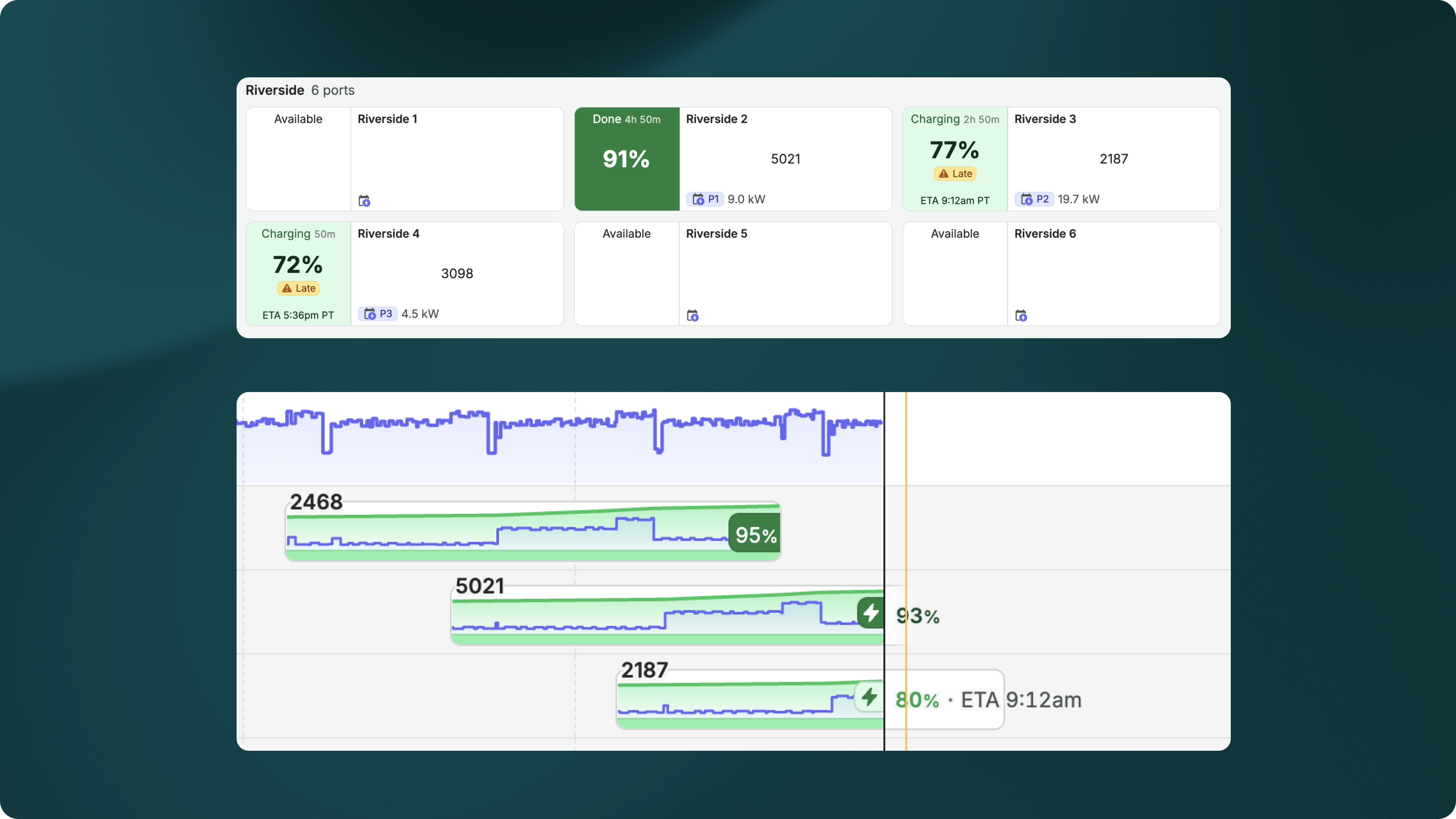
- Remote monitoring displays the real-time status of every charger across all charging sites (online, occupied, idle, faulted), the state-of-charge of each vehicle, and the ETA of charging completion.
- Text-message alerts notify operators as soon as abnormal behavior starts, enabling proactive maintenance before vehicles are affected.
- Operators can set departure schedules for vehicles, which makes the “late” icon pop up when a vehicle is expected to finish charging past departure time.
- Vehicles can also be prioritized and charged accordingly, i.e. vehicle sessions tagged as lower priority will wait until higher priority ones finish.
Once these guardrails for vehicle availability are in place, disruptions in typical schedules will be surfaced hours in advance vs. having to be resolved real-time.
2. Minimizing electricity costs via load management
Electricity costs break down into two components: power usage and demand charges. Operators can save on costs using a CMS’ dynamic load management (also referred to as energy management or power management), which coordinates charging across vehicles and chargers.
For savings in power usage, operators can shift charging to off-peak hours (when electricity is less expensive) by limiting power usage during certain hours. Given the power limits, dynamic load management coordinates charging and power consumption across vehicles and chargers accordingly.
In the example below, the operator sets the power limit to 0 kW from 4-9pm. As a result, even when vehicles return from their routes at 5pm and plug in, they do not start charging until 9pm and avoid consuming power when it’s most expensive. The vehicles still get fully charged overnight.
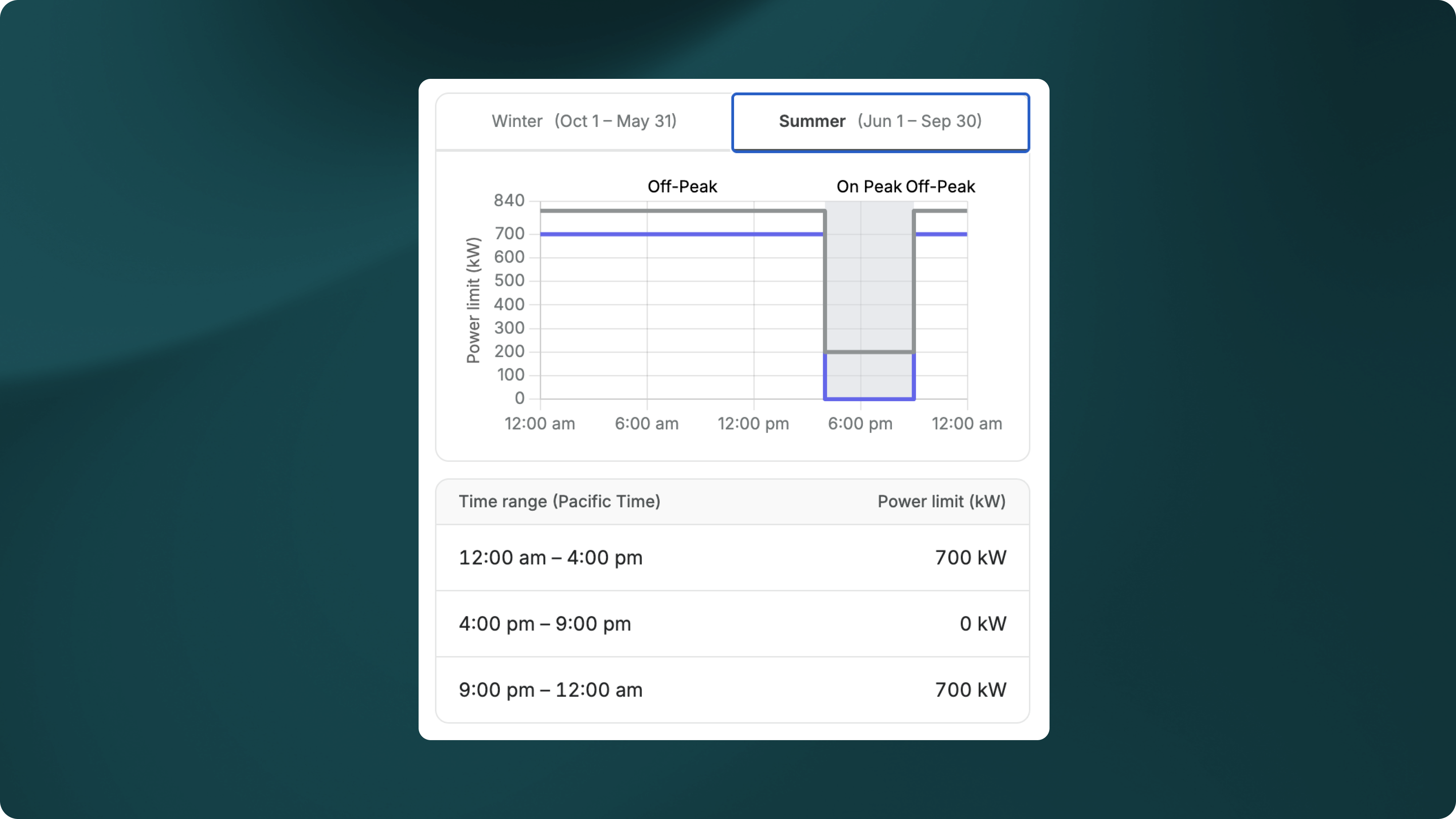
Site power limits also reduce demand charges by limiting spikes in power usage and smoothing it out over longer periods of time.
For fleets with on-site energy resources, DER and microgrid integrations enable charging to take advantage of solar, battery storage, or other distributed energy assets and reduces reliance on grid power at peak times.

For larger-scale energy management or microgrid use cases, read more about our EV load management device / onsite controller here.
3. Streamlining day-to-day fleet operations
Functional and efficient operations rely on simple day-to-day monitoring and proactive maintenance, plus analysis of past behavior to find new efficiencies.
Beyond real-time charger status, data aggregation and analysis are critical to highlight recurring problems. Charger utilization history, failure rates, session success, and dwell times might show that a depot has too few / too many chargers, or that a certain type of hardware experiences recurring issues.
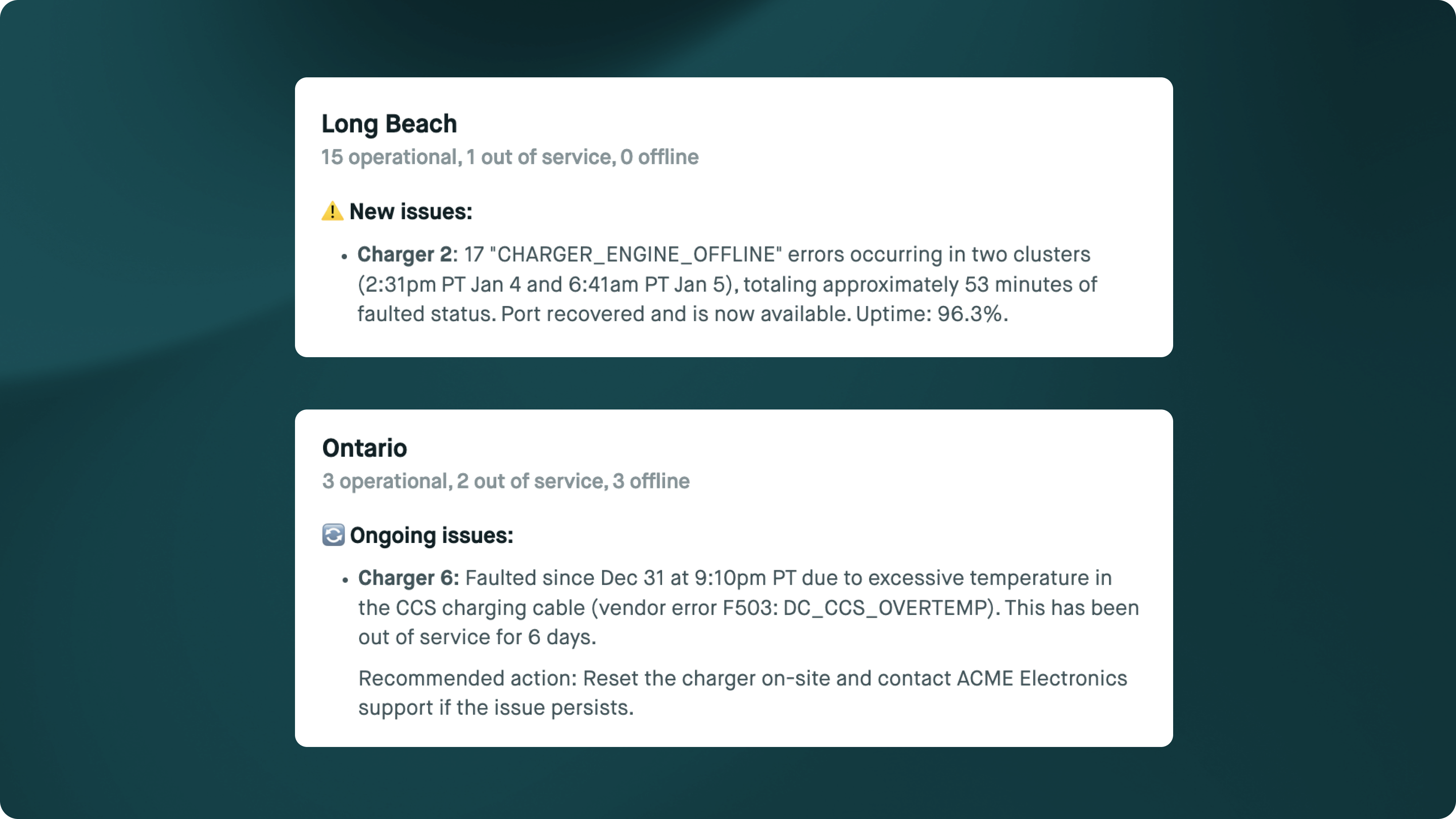
To make monitoring even simpler, Flipturn’s platform has an AI charging operations agent that summarizes all irregular charger behavior and faults in one daily email with clear next steps, so maintenance teams know exactly what to pay attention to.
Lastly, integrations with fleet telematics systems (e.g. Geotab, Samsara) consolidates fleet data into one platform for operators to see vehicle location, state-of-charge, and usage data all at once.
Interested in learning more about Flipturn’s fleet features? Connect with one of our experts here.
Flex Connect
Flipturn is one of three approved Solution Providers for PG&E’s Flex Connect program, which lets EV charging sites quickly get additional site capacity while waiting for infrastructure upgrades. Read more here about how Flipturn’s platform supports Flex Connect.
If you are a fleet operator looking to expand your site and / or enroll in Flex Connect, we’d love to chat. Please mention “Flex Connect” in your submission.
Real-world case studies
Flipturn’s CMS is purpose-built for fleet operations and reliability; we work with large enterprise fleets to ensure maximum uptime and efficiency across all charging sites.
Read more about how Flipturn powers best-in-class EV fleets in our customer case studies: