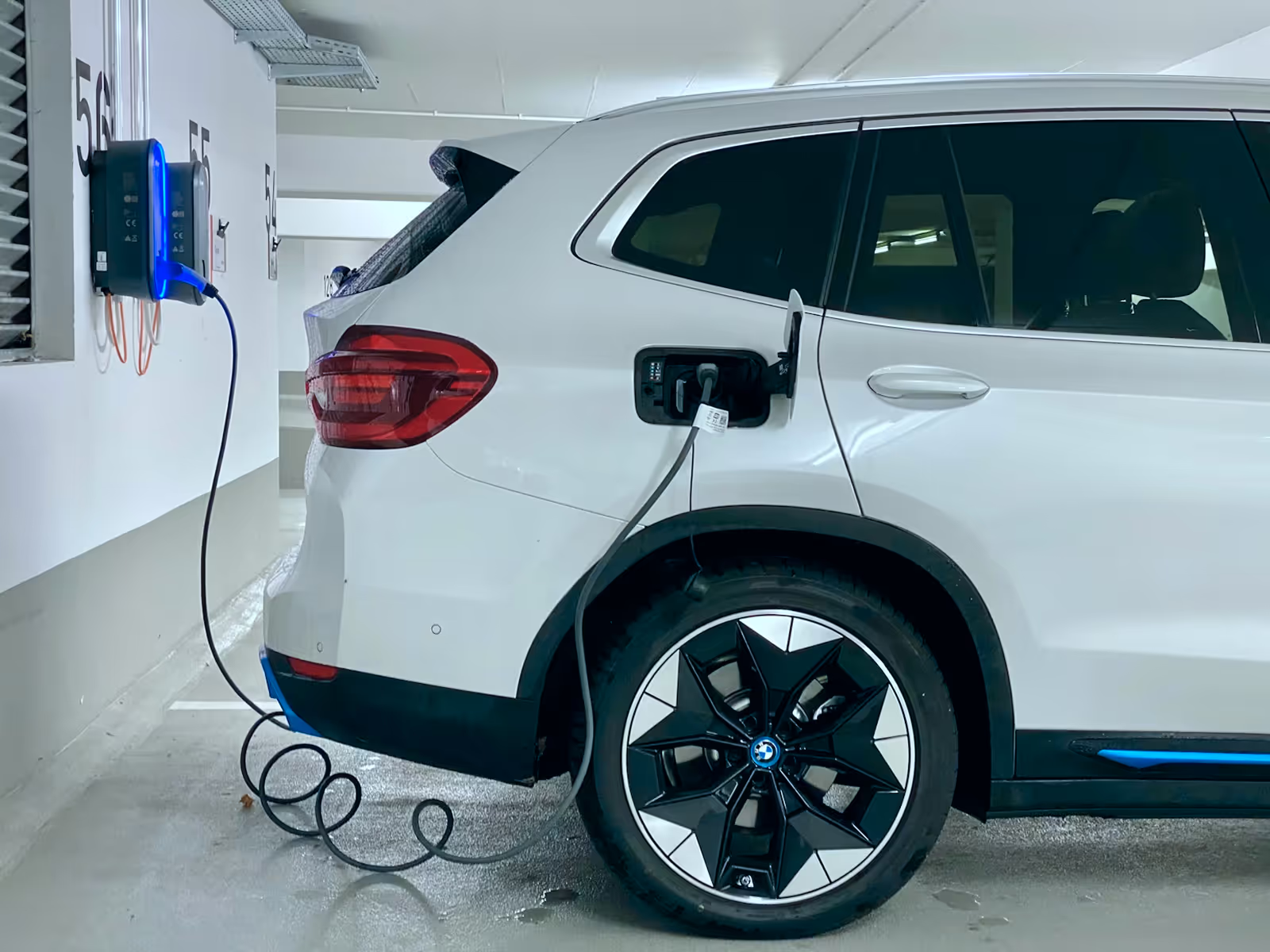
A wide range of service providers depend on vans to keep their businesses running. That includes those carrying cargo, equipment, or passengers. If your business uses vans for your daily operations, switching to electric vans (EVs) could save you thousands of dollars.
In the last few years, several companies have started making and selling electric vans, and while they usually cost more upfront than a gasoline or diesel van, they generally have lower fuel and maintenance costs. This means electric vans can cost less than traditional internal combustion engine (ICE) vans overall. Plus, incentive funding is available to bring down the upfront cost significantly (as well as operating costs in some states, like California, Oregon, and Washington). Flipturn also maintains a database of EV charging rebates and incentives by state and utility.
Breaking it down: what costs go into the equation?
Costs you pay either way:
- Vehicle purchase (price + taxes)
- Fuel or electricity
- Vehicle maintenance
Costs specific to electric vans:
- Charging infrastructure (if installing private chargers)
- Charger maintenance
Offsets specific to electric vans:
- Incentive funding for both upfront and ongoing costs, varies by state and utility (See Flipturn's rebates and incentives database for current programs.)
The lower fuel and maintenance costs for EVs make it possible for a fleet to make up the additional upfront cost of these vehicles within their service lifetimes. How fast your business makes up the difference depends on a few things, primarily how much you drive.
Let’s look at an example
Let’s say you operate a gasoline-powered cargo van that is nearing the end of its life, and you are deciding whether to replace it with another gasoline van or an electric one. We have to make some assumptions about your day-to-day operations, so let’s assume:
- You are a local home service provider (e.g., solar installer, general contractor, HVAC technician, etc.);
- You operate in Los Angeles, CA;
- You drive 75 miles per day on average;
- You can charge an EV at your office or shop overnight for 8 hours; and,
- You drive your vans for about 8 years before replacing them.
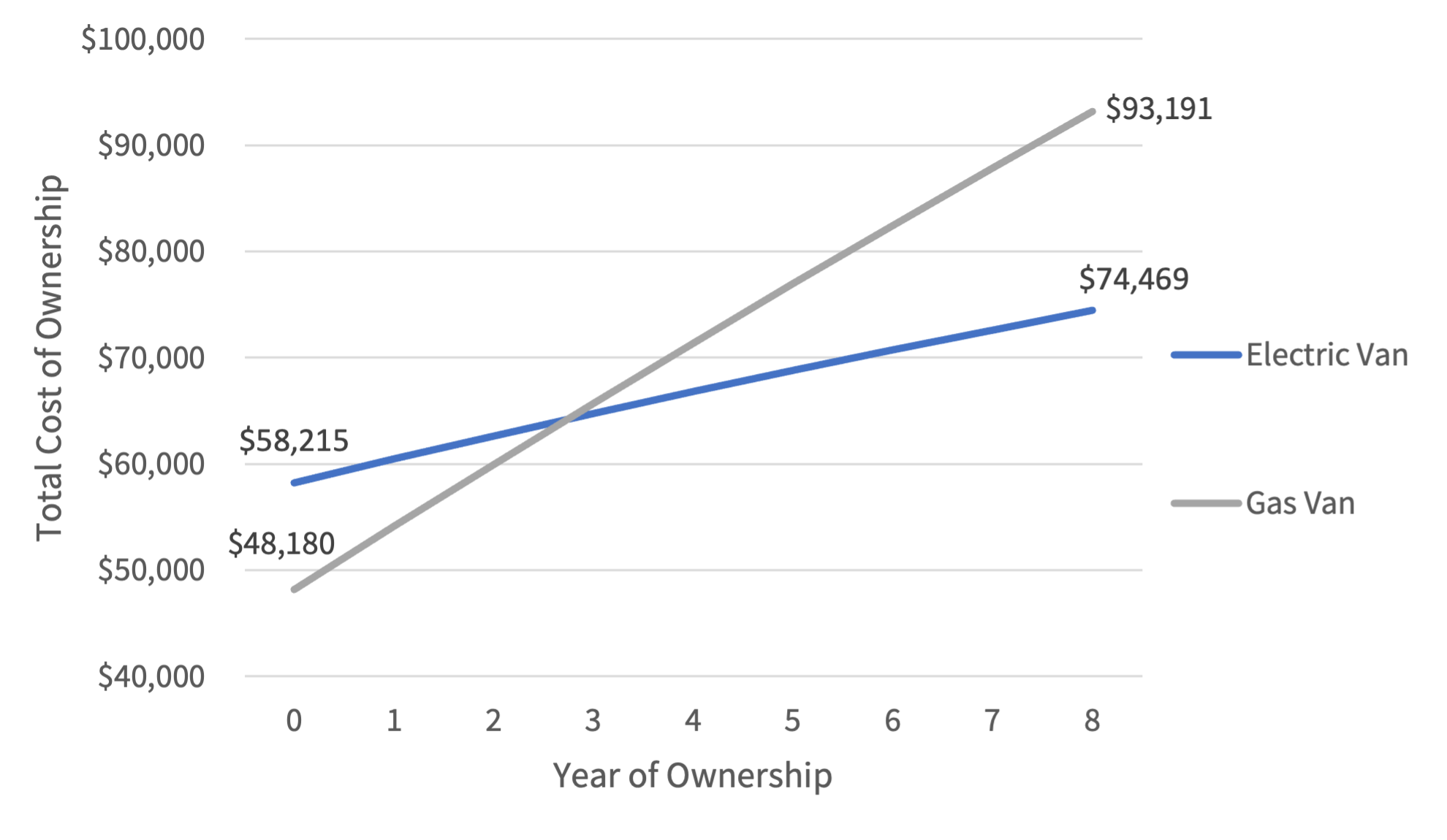
The figures below show estimates for the TCO of operating a gas van versus an EV under these conditions, reported in today’s (2023) dollars.
For a deeper breakdown of the variables that drive EV cost per mile across fleets of different sizes and duty cycles, see our analysis of the three main factors affecting EV cost per mile.
Electric vs Gasoline Cargo Van - Total Cost of Ownership (Payback Period)
Electric versus Gasoline Cargo Van - Total Cost of Ownership (Detailed)
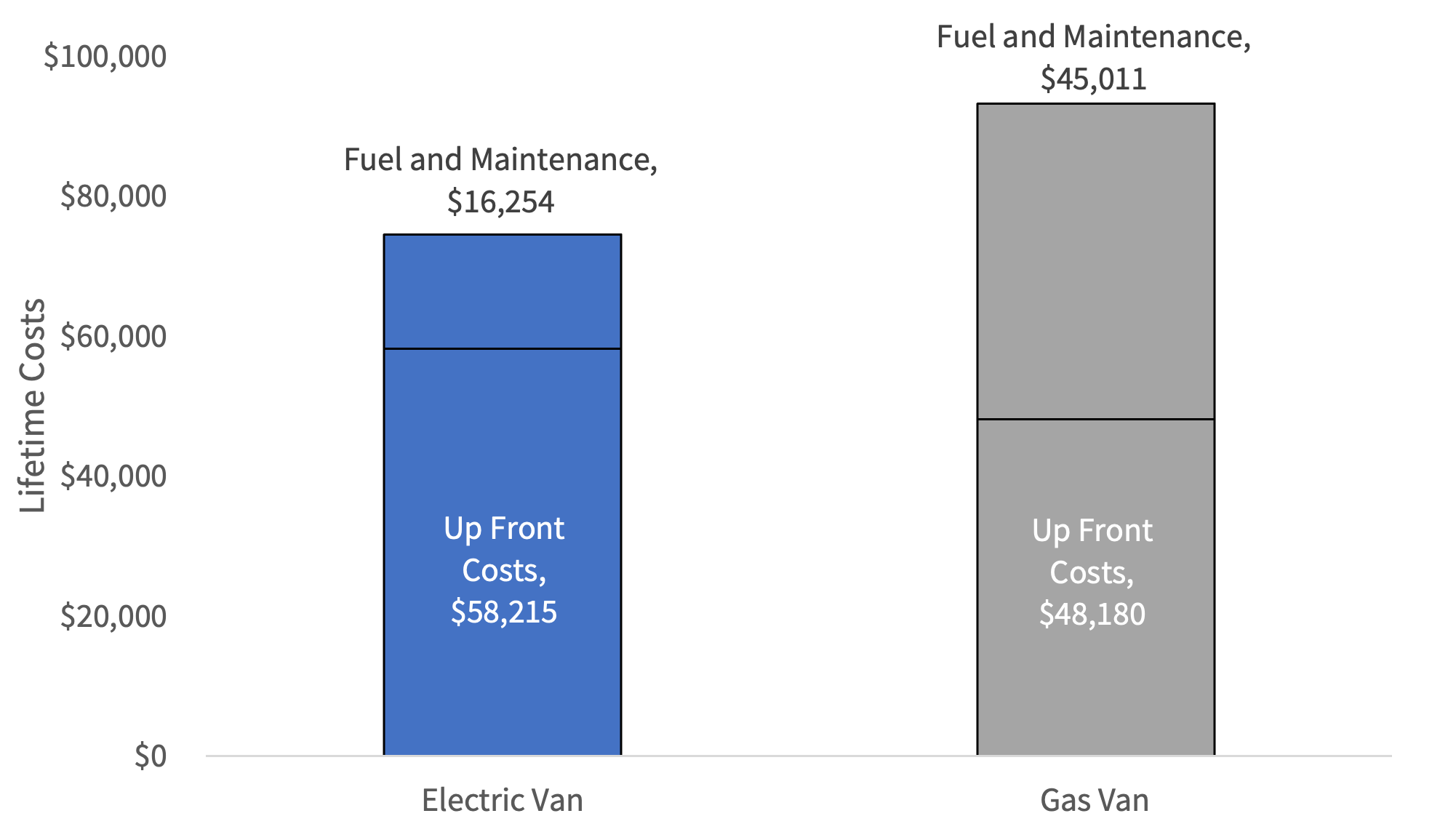
In this example the electric van would cost about $17,500 more upfront than the gasoline van due to a higher purchase price and the cost of a charger, in the absence of EV incentives. However, this example does include a $7,500 vehicle purchase incentive from the California Hybrid and Zero-Emission Truck and Bus Voucher Incentive Project (HVIP), dropping the vehicle price difference to $10,000 (see the US Department of Energy’s Laws and Incentives Database for more information on incentives). Despite the higher upfront cost, the EV would have significantly lower operating costs.
All in all, this leads the EV to reach a break-even point with the gasoline van in about 3 years and to create an estimated lifetime savings of nearly $19,000.
The operating-cost gap widens further when fleets actively manage charging — smart load management and time-of-use scheduling can reduce electricity costs by another 20–60% on top of the baseline assumptions in this analysis.
What electric vans are available on the market?
There are at least 10 vehicle manufacturers making electric cargo vans in the US and Canada, including mature companies like Ford and General Motors (BrightDrop) and relatively younger companies like Envirotech and GreenPower Motor Company, according to the Zero Emission Technology Inventory. And, the number of manufacturers increases when considering other similar body styles like step vans and box trucks.
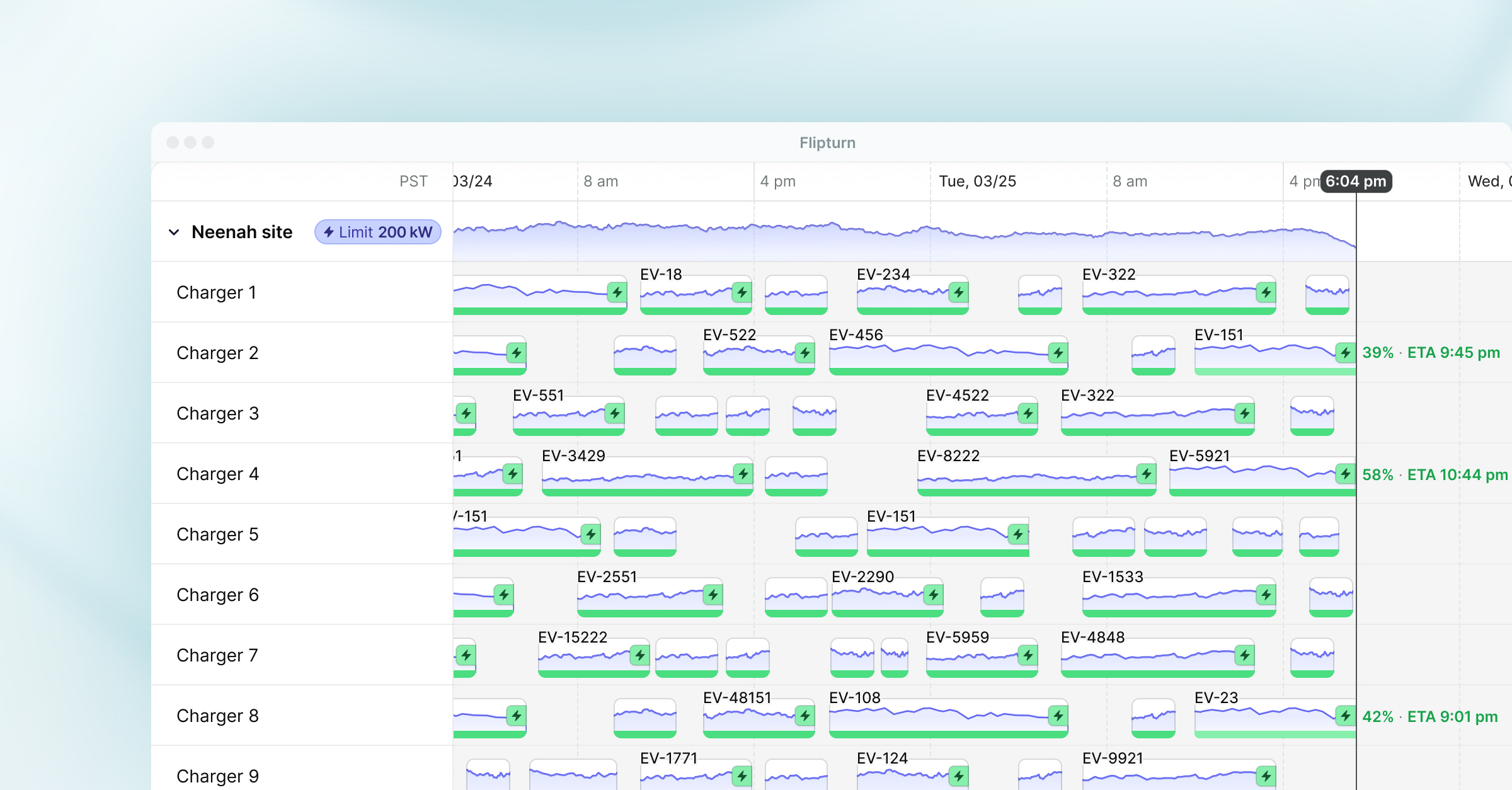
With a growing number of commercial electric vehicles available on the market, the harder problem is operating them efficiently once they're in service. Flipturn is the EV charging and energy management platform fleets use to keep vehicles ready, reduce charging costs, and unify operations across mixed hardware. Read our guide to EV fleet charging for a complete operational overview, or book a demo to see how fleets like Purolator and Zeem Solutions run their EV operations on Flipturn.
Our assumptions
Results vary by vehicle features, operating location, daily mileage, and charger selection. The figures in this analysis use the following assumptions:
Purchase price
Gas van: $44,000. Electric van: $57,000. Sources: Ford Transit cargo van pricing and Ford E-Transit pricing and incentives.
Sales tax
9.50% (City of Los Angeles, CA). Source: California Department of Tax and Fee Administration sales tax rates.
Charger hardware and installation
Hardware: $800. Installation: $2,500. Sources: Ford Connected Charge Station pricing and a ScienceDirect analysis of EV charging infrastructure costs.
Gasoline costs
$4.55/gallon in Year 1 of operation (Los Angeles County, January 26, 2023). Source: EIA weekly retail gasoline and diesel prices.
Electricity costs
$0.07082/kWh in Year 1 of operation, plus other fees per Los Angeles Department of Water and Power's Small Commercial and Multi-Family Time-of-Use Rate A-1B. Source: LADWP residential and commercial rates.
Maintenance costs
Gas van: $1,000/month in Year 1 of operation on average. Electric van: $600/month in Year 1 on average. EV charger: $400/year. Sources: Argonne National Laboratory's analysis of EV vs. ICE scheduled maintenance costs (which estimates EV maintenance to be ~40% less costly) and the DOE Alternative Fuels Data Center on charging infrastructure maintenance.
Fuel economy
Gas van: 17 miles/gallon. Electric van: 0.56 kWh/mile (67 kWh battery capacity divided by 120 miles of range). Sources: Car and Driver — Ford Transit and Car and Driver — Ford E-Transit.
Incentives
$7,500 in vehicle purchase incentives are assumed for the electric van. This figure is derived from California HVIP's 2022–2023 Funding Tables, assuming the gross vehicle weight rating of the Ford E-Transit at 9,500 lbs — Class 2b Sources: Ford E-Transit cargo van specifications and the California HVIP funding tables. For current EV charging and vehicle incentives by state and utility, see Flipturn's rebates and incentives database.
Future fuel and maintenance costs
Gasoline, electricity, and maintenance costs change over time, so the analysis incorporates the following projections:
- Compound annual growth rate for gasoline: 3.41%
- Compound annual growth rate for electricity: 2.20%
- Compound annual growth rate for vehicle maintenance: 3.07%
- Discount rate: 5%, applied to estimate the net present value of future costs
Sources for the growth rates: gasoline and electricity CAGRs come from the US Energy Information Administration's Annual Energy Outlook 2022 — Table 12 (Petroleum and Other Liquids Prices, nominal $/gallon, 2023–2031) and Table 3 (Energy Prices by Sector and Source, nominal $/MMBTU, 2023–2031) respectively. The vehicle maintenance CAGR comes from the Federal Reserve Bank of St. Louis Consumer Price Index for Motor Vehicle Maintenance and Repair, Compounded Annual Rate of Change, Seasonally Adjusted, 2000–2022.