.jpeg)
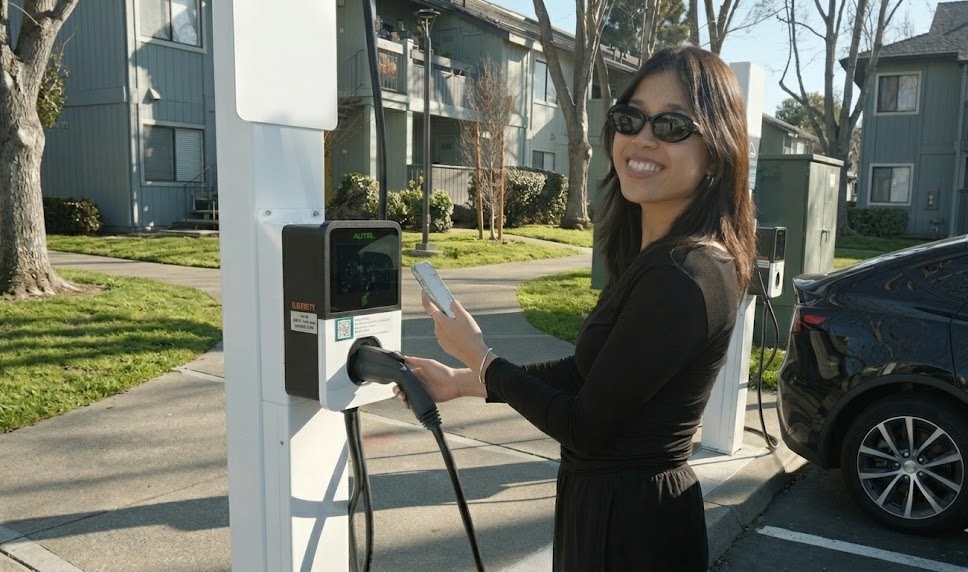
Electric vehicle (EV) charging is quickly becoming a baseline expectation for multifamily properties. As more and more tenants adopt EVs, property owners nationwide are deploying chargers portfolio-wide to attract and retain the EV driver demographic.
However, cost can be a real prohibiting factor. Property owners sometimes worry about investing upfront in EV charging, or they might face limited budgets that make EV charging seem out of the question altogether.
The market has quickly evolved to meet these concerns. EV charging technology has improved rapidly over the past 5 years, bringing the cost of a Level 2 charger down to $700-$1000 in many cases. Many owners are now also opting for open ecosystem providers (vs. closed ones), who can generally offer lower prices.
Furthermore, property owners now have several ownership models available to them, providing cost and operational flexibility. Below, we’ll cover the three models and each of their strengths & drawbacks: owner-funded, no-cost (third party operated), and charging-as-a-service.
Owner-funded model
The owner-funded model is what most people are familiar with: the owner purchases hardware, software, and installation services, then continues to operate / maintain the chargers and collect session revenue.
This model offers owners complete control and visibility into their charging operations. Property teams can decide on pricing and access controls (whether the chargers are restricted to solely residents, or if the public can also charge, such as with a guest rate).
For example, some owners may want to offer charging as a free amenity to residents. Others may want to monetize and have EV charging as an ancillary revenue stream. The owner-funded model allows them to make and implement those decisions.
The drawback is that it requires the most upfront investment out of the three ownership models. The owner is responsible for paying for hardware, software, and installation. However, local utilities in many states offer rebate programs to subsidize project costs (often over 50%) and incentivize EV adoption.
For property owners who want complete control over charger operations, the owner-funded model allows them to make all pricing, access, and deployment decisions. The owner can run charging exactly as they want it.
No-cost (third party operated) model
The no-cost model involves no investment from the owner. A third party (typically an EV charging-specialized investor) purchases the hardware, software, and installation services. This third party then continues to operate and maintain the chargers.
Since they are the upfront investor, the third party is entitled to the charger revenue. Some investors will also offer a revenue share arrangement so property owners can see some financial upside.
This model allows for owners to benefit from having EV chargers at their property (tenant attraction and retention, rent premiums) without paying any upfront costs. Furthermore, maintenance teams do not shoulder additional amenity care responsibility. The third party takes on capital risk and operational workload.
However, by handing off financial responsibility, owners sacrifice revenue upside and absolute control over operations. Contracts are also typically longer (7-12 years) to protect the capital provider.
For property owners who are capital-constrained or would prefer an EV expert to make deployment and operational decisions, the no-cost option provides the opportunity to secure charging without as much involvement.
Charging-as-a-service (CaaS) model
The charging-as-a-service (CaaS) model is nearly identical to the owner-funded model, except the owner rents the equipment instead of purchasing it. In a CaaS model, the owner still collects all charging revenue. A third party (usually the company who is leasing out the equipment) is responsible for maintenance.
The CaaS model is essentially a mix of the previous two models: no CapEx risk, but the property owner still owns the chargers for the duration of the contract.
The drawback to the CaaS model is that the owner incurs higher costs in the long term compared to the owner-funded model, similar to how renting skis and paying per day ends up costing more than buying your own skis once (after a certain number of days). Additionally, CaaS contracts are usually longer, often an 8+ year commitment.
For owners who are not willing to front the CapEx of the owner-funded model but still want owner control, the CaaS model is a great option.
Summary
In short, multifamily property owners have a variety of EV charging ownership and cost models available to them, with options for all budgets and teams:
- The owner-funded model involves CapEx investment and gives the owner complete operational control and revenue upside
- The no-cost model hands cost and operational responsibility completely to a third party
- The CaaS model is an in-between that removes CapEx risk in return for recurring payments, and allows the owner to collect driver revenue
The best option for each owner depends on a variety of factors, including budgets, regional EV adoption, and rebate availability. All three enable owners to maintain a competitive edge with the rapidly growing EV driving tenant demographic.
If you would like a consultation to determine which model is a best fit for your property, or you already have one in mind, speak to one of our EV experts here.
About Flipturn
Flipturn is the leading EV charging and energy management platform for businesses and fleets, helping organizations maximize charger uptime, process charging payments, and scale operations efficiently. Backed by leading investors including CRV and Accel, Flipturn serves Fortune 500 companies, commercial property owners, and major fleet operators across North America.