

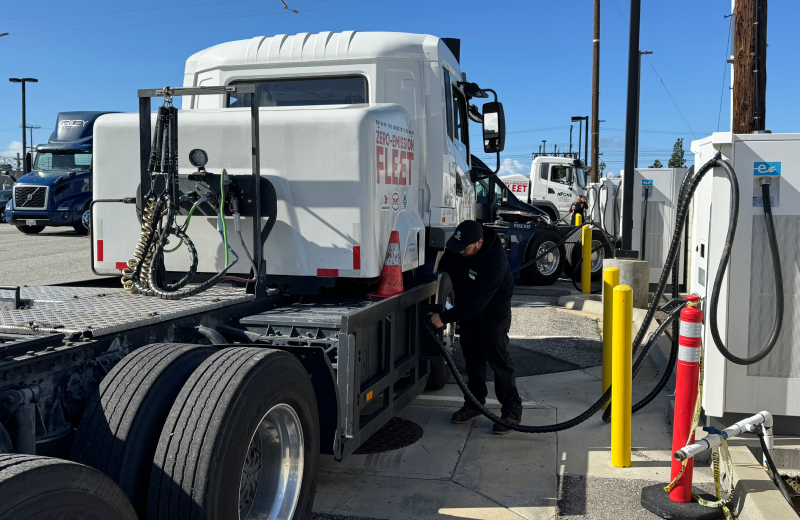
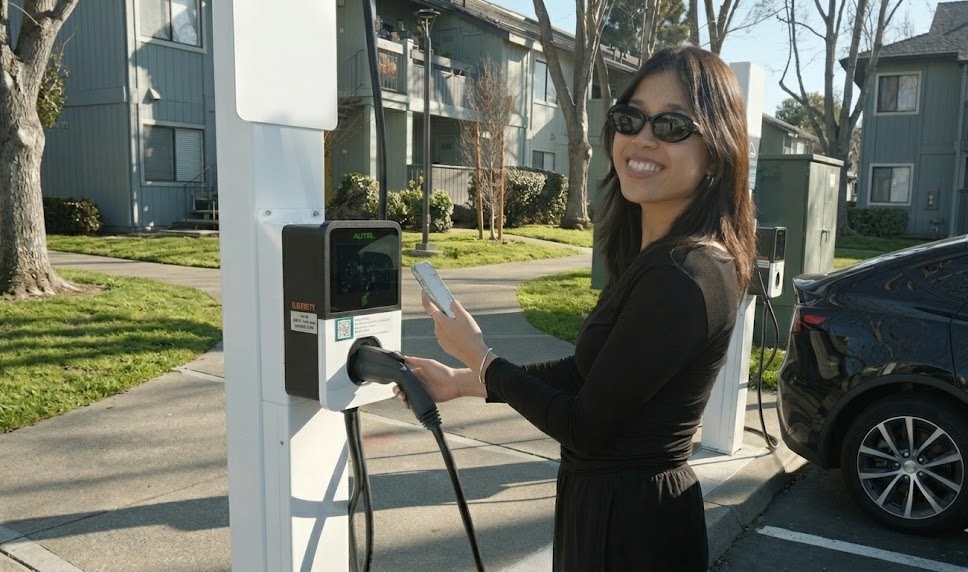
There are three categories of chargers: Level 1, Level 2 (L2), and DC fast chargers (DCFCs). Level 1 chargers are the equivalent of plugging your car into a normal electrical outlet, so they're rarely used for commercial fleet charging. Fleets typically choose between Level 2 and DCFC.
Level 2 chargers cost less than DCFCs, so many fleets choose them as the default. There are good reasons to choose DCFCs, especially if you need fast charging or operate heavy-duty vehicles. Let's look at the differences first.
Differences between Level 2 and DCFCs
Maximum power output
Level 2 chargers typically range between 7 and 21 kW. DCFCs range between 40 and 350 kW. With higher power output, DCFCs charge faster: a DCFC can charge a delivery van in 30 minutes; a Level 2 charger may take overnight.
Cost
DCFCs are much more expensive than Level 2 chargers, by an order of magnitude or more. A DCFC unit can cost from $20,000 to $100,000. Level 2 chargers range from $500 to $5,000.
Site power infrastructure requirements
Because DCFCs require 10-20x more power than a lower-end Level 2 charger, there's a real risk that a site's electrical infrastructure can't support more than 1 or 2 DCFCs. If your power panel is rated for 1000A, it can support around 30 Level 2 chargers but fewer than 8 DCFCs. Working with your utility to upgrade your site's electrical infrastructure for DCFCs can take 1 to 3 years.
Data reporting: state of charge and vehicle ID
As covered in our post on getting the most detailed data from your fleet EV chargers, DCFCs report more data than Level 2 chargers. Level 2 chargers report real-time charging status, power usage, and cumulative energy usage across a charging session. They do not report which vehicle is charging; vehicle identity and state of charge have to come from vehicle telematics.
DCFCs report the ID of the vehicle plugged in and the real-time state of charge of the vehicle. With this extra information, Flipturn's fleet charging management can predict when a vehicle will be fully charged, control charging speed based on vehicle identity or schedule, and more. This functionality is only possible on L2 chargers when telematics integrations or manual input associate vehicle identity and state of charge with a charging session.
What’s right for your fleet?
Because L2 chargers are much cheaper than DCFCs to purchase and install, they're often the most practical option. Not all fleets can charge using L2 chargers, though: an L2 charger may not charge fast enough, and they're impractical for many heavy-duty vehicles.
You may opt for DCFCs if any of the following apply to your fleet.
Incentive and grant programs eligibility
DCFCs cost an order of magnitude more than Level 2 chargers, but ample incentive programs subsidize their purchase and installation. There's particularly significant funding available in California for DC fast charging sites. Before investing in charging infrastructure, check whether you qualify for subsidies using our EV charging incentives database.
Short dwell times for charging
If your vehicles need to charge in an hour or less, you need a DCFC. If you have overnight to charge, L2 is often enough.
Think of pouring water into a glass: the rate at which you pour affects how long it takes to fill the glass. EV charging is similar. A higher-kW charger fills a battery faster than a lower-kW one. Because a DCFC can deliver 10-20x as much power as an L2 charger, it can charge a vehicle up to 10-20x faster.
Heavy duty vehicles
Heavy-duty vehicle fleets usually need DC fast charging, though transit bus fleets often have short enough routes to charge overnight with L2. Light- and medium-duty fleets can usually choose L2, but may also install 1-2 DCFCs on site for quick opportunity charges.
The glass-of-water metaphor applies here too: the larger the glass, the longer it takes to fill at the same pour rate. A class 8 truck has a bigger battery than a delivery van, so it takes much longer to charge with the same charger. While a Level 2 charger can charge a delivery van overnight, it may take days to charge a class 8 truck, and parking a vehicle at a charger for days isn't realistic for most fleets.
Visibility needs
L2 chargers can't directly provide information on vehicle state of charge or identity. Most charging management systems won't be able to provide detailed visibility into Level 2 charging sessions, including which vehicle is charging at each charger or the estimated time until charging completion.
In some cases, Flipturn can use vehicle data integrations to map L2 charging sessions to vehicles and use that mapping to report state of charge. While this AI-powered matching helps provide visibility into depot operations, it depends on good data quality from vehicle telematics. Vehicle data quality can vary widely across makes and models. If detailed vehicle-first visibility into charging is a top priority, that's another reason to lean DCFC.
Choosing between L2 and DCFC: a quick framework
Fleets with class 2 or 3 vehicles (passenger cars, delivery vans, and similar) often choose Level 2. Most heavy-duty fleets need DC fast chargers. Both make sense from a budgetary and logistical standpoint, but fleets running L2 can struggle with visibility across their depots.
Even with Level 2 charging, Flipturn provides visibility into vehicle readiness, state of charge, and scheduling. Book a demo to see what's possible at your sites.
About Flipturn
Flipturn is a leading charging management solution for fleets. The platform combines energy management to minimize utility costs, charger monitoring to improve uptime and issue resolution speed, and fleet charging management for cost per mile and range insights.

.jpeg)